


Initiation
How did we come up with this project
Our team formed in June 2025 after meeting at our Robotics Innovation Lab. Motivated by the collision risks rigid arms face with irregular space debris, we united to address the growing problem of orbital congestion. Our goal is to develop a soft grappling system that is safer and more adaptable than existing solutions
Innovation Process
How are we inspired and what innovations did we make
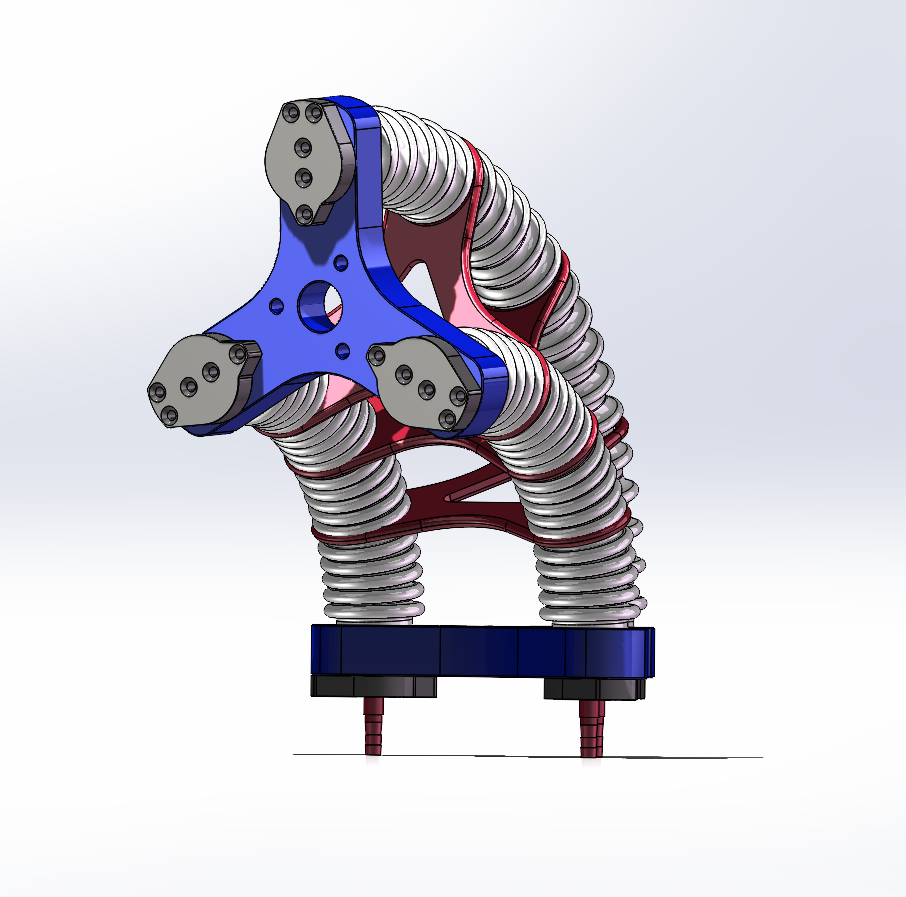

· Bio-inspired structure:
The soft arm bends like an elephant trunk to grasp and collect space debris.
· High adaptability:
The soft arm achieves 198% extensibility, allowing the main satellite body to stay at a safe distance from debris. A gear structure at the top enables 360° rotation; combined with the arm’s 3-DOF bending, it can efficiently and precisely capture debris from any direction. A mature soft robotic gripper is used to avoid creating secondary fragments.
· Precise control:
The gripper end includes a fine adjustment mechanism. An electric actuator drives a linkage to provide 30 mm of positional micro-adjustment, ensuring stable grasping and collection. Radar-based shape recognition guides the arm’s bending so the gripper reaches the optimal contact surface.
· Independent collection, reusable operations:
The soft robotic arm functions as a self-contained satellite with independent power storage and mobility. By traveling between the mothership and the target area, it can collect debris in multiple batches over repeated missions.